By harnessing energy available in the environment, it helps to extend the lifespan of devices and, in some cases, eliminate the need for batteries altogether.
In this article, we will explore why energy harvesting is a promising solution, how it works, its challenges, and its benefits for your IoT projects.
Why incorporate energy harvesting into your IoT project?
The Internet of Things (IoT) is booming, with millions of sensors deployed across a wide range of sectors: industry, healthcare, smart buildings, logistics and agriculture.
However, ensuring these devices are self-sufficient in terms of energy remains a major challenge.
Energy harvesting provides a practical solution by enabling sensors and connected devices to be powered autonomously, thereby reducing their reliance on conventional batteries.
The benefits for your IoT project
- Reduced maintenance costs: less maintenance required thanks to the elimination or extended lifespan of batteries. Let’s take the example of deploying a fleet of connected devices. Battery management is a major challenge. While the initial battery is designed to last 5 to 10 years, replacing it in the field incurs significant costs in terms of time and resources. By integrating energy harvesting, these interventions can be reduced or eliminated, thereby optimising the total cost of ownership (TCO).
- Performance optimisation: thanks to a continuous power supply from the environment, your sensors and IoT devices can operate without interruption, ensuring a more stable service.
- Eco-design and sustainability: by limiting the use of batteries containing rare and hard-to-recycle materials, energy harvesting helps reduce electronic waste and the carbon footprint of connected products. The use of supercapacitors combined with renewable energy sources (solar, thermal, vibrational, electromagnetic or air flow) helps minimise the use of chemical components and makes devices more environmentally friendly.
A forward-looking technology for sustainable projects
The adoption of energy harvesting forms part of a comprehensive eco-design approach aimed at reducing the environmental impact of technologies.
In a world where connected devices are becoming increasingly widespread, minimising their energy consumption and their reliance on non-renewable resources is becoming a priority. Thanks to this technology, it is possible to design smarter solutions, tailored to today’s ecological and economic challenges.
Integrating energy harvesting not only optimises the sustainability of your products but also adopts a more responsible approach aligned with sustainable development requirements. An essential revolution for project leaders seeking high-performance, environmentally friendly solutions.
To learn more about eco-design, we recommend this article on the subject.
How does energy harvesting work?
Energy is captured from the environment using various technologies.
Let’s look at some specific use cases:
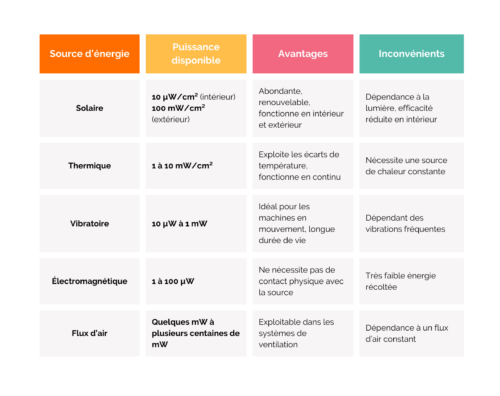
1. Solar energy: this is one of the most commonly used sources for energy harvesting. It is ideal for objects outdoors or even indoors where there is good light exposure.
Available power / harvested energy:
- Outdoors (full sunlight): ~100 mW/cm²
- Indoors (artificial light): ~10–100 µW/cm²
Advantages:
✅ Abundant and renewable energy source
✅ Suitable for bright outdoor and indoor environments
✅ Mature technology with constantly improving efficiency
Disadvantages:
❌ Dependence on light (an issue in darkness or low light)
❌ Limited efficiency indoors
Examples of applications:
- Outdoor applications: Environmental monitoring, connected agricultural sensors, logistics tracking systems.
- Indoor applications: With advances in photovoltaic cells, even ambient light can power devices such as smart sensors for energy management, equipment monitoring or occupancy monitoring.
2. Thermal energy: temperature differences between two points (for example, between an engine and the ambient air) can be harnessed to generate energy, particularly through systems such as Peltier modules.
Available power / harvested energy:
- Typically 1 to 10 mW/cm², depending on the temperature difference
Advantages:
✅ Can be used in industrial environments where temperature differences are common
✅ Operates continuously as long as there is a thermal gradient
Disadvantages:
❌ Dependent on the presence of a constant temperature difference
❌ Relatively low efficiency compared to other sources
Examples of applications:
- Industrial sensors
- Monitoring devices in environments with significant temperature variations
3. Vibrational energy: vibrations or mechanical movements can be converted into electrical energy using piezoelectric or electromagnetic systems. Although the amount of energy recovered is modest, this method is useful for objects subjected to regular vibrations.
Available power / energy harvested:
- Typically 10 µW to 1 mW, depending on the intensity of the vibrations
Advantages:
✅ Can be used on equipment in constant motion (industrial machinery, bridges, railway tracks)
✅ Low maintenance and long service life
Disadvantages:
❌ Requires frequent vibrations to be effective
❌ Often modest amount of energy
Examples of applications:
- Predictive maintenance on industrial machinery
- Infrastructure monitoring (bridges, railway tracks)
Moreover, when combined with embedded AI, it enables vibration data to be analysed directly on the device, thereby detecting anomalies without the need for constant data transmission.
To find out more, read our article on embedded AI and its key role in predictive maintenance.
4. Electromagnetic energy: Ambient electromagnetic waves (Wi-Fi, Bluetooth, mobile signals) can be captured and converted into energy using specialised antennas. This method is suitable for devices requiring very little energy.
Available power / harvested energy:
- Between 1 and 100 µW, depending on proximity to RF sources
Advantages:
✅ Requires no physical contact with the source
✅ Compatible with urban environments where waves are ubiquitous
Disadvantages:
❌ Very low energy yield, suitable only for ultra-low-power devices
❌ Dependence on the presence of RF signals
Although the amounts of energy harvested are often modest, a well-designed object, optimised for low power consumption, can operate for years, or even indefinitely in some cases.
Examples of applications:
- RFID tags
- Wearable medical sensors
- IoT devices for logistics
5. Energy from air flows: Air movement can be harnessed to generate energy using miniaturised turbines and suitable energy recovery systems.
Available power / energy harvested:
- Typically a few mW to several hundred mW, depending on the speed of the air flow
Advantages:
✅ Abundant energy source in ventilation systems and industrial environments
✅ Can be integrated into autonomous wireless systems
Disadvantages:
❌ Dependence on a constant air flow to maintain energy production
❌ Requires a suitable turbine and energy conversion system
Example: the e-VAV project on which we worked for F2A.
The e-VAV variable air volume damper is a standalone, connected controller that manages fresh air flow in commercial premises and school buildings. It adjusts the air flow according to requirements and measures air quality using its built-in sensors.
Its innovation lies in its energy self-sufficiency: it generates its own energy via an integrated turbine and an energy recovery system.
Which energy source should you choose?
How can you successfully integrate energy harvesting into your IoT project?
Are you convinced of the potential of energy harvesting, but wondering how to integrate it effectively into your IoT device? Here are the key steps:
- Define your precise energy requirements: Assess your device’s power consumption to identify the best energy source.
- Choose the right technology: Solar, thermal, vibration, electromagnetic… each technology has its own constraints and advantages.
- Optimise energy management: Use controllers, supercapacitors and efficient storage to ensure stable operation.
- Test under real-world conditions: Prototype and test battery life to validate performance before deployment.
Technical challenges to anticipate in your project
Whilst energy harvesting opens up opportunities, it also imposes technical constraints that must be taken into account right from the design stage of your IoT device.
- Energy storage and management: integration of supercapacitors and rechargeable batteries to manage energy fluctuations.
- Optimising power consumption: developing ultra-low-power sensors and microcontrollers.
- Custom design: selecting the energy harvesting technology best suited to your use case.
Integrating these aspects from the outset of your project is essential to ensure your product’s viability and avoid costly adjustments during the development phase.
Rtone supports you in your IoT project
Energy harvesting presents a major opportunity to design connected devices that are smarter, more self-sufficient and more sustainable. However, integrating it requires specialist expertise in hardware design, energy management and software optimisation.
At Rtone, we support IoT project leaders in integrating energy harvesting solutions.
Thanks to our expertise in developing connected devices and energy management, we help you design high-performance, cost-effective and environmentally friendly products.
Do you have an IoT project and want to explore energy harvesting? Contact us!