Do you have a brilliant idea and want to turn it into reality? Moving from a proof of concept to a prototype involves completing several key steps. Here’s how to go about it, with our practical, tried-and-tested advice.
Do you have a brilliant idea and want to turn it into reality? Moving from a proof of concept to a prototype involves completing several key steps. Here’s how to go about it, with our practical, tried-and-tested advice.
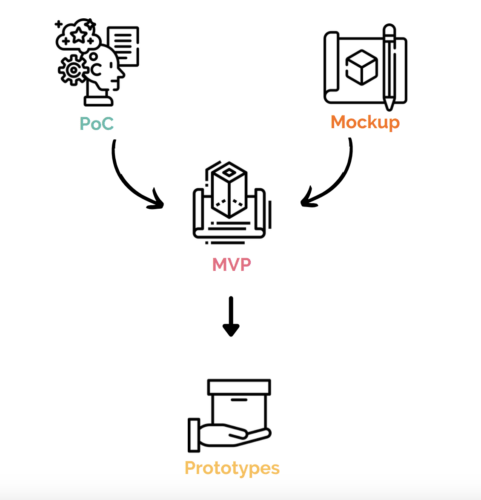
In this guide, we have deliberately omitted the term ‘prototype’. In our view, each phase is a prototype with its own specific ambitions and objectives. In this framework, we would generally advise you to run the PoC and mock-up stages in parallel to minimise the time taken to reach the production prototype.
Starting with your idea, you will need to demonstrate its technical feasibility fairly quickly. This is where the PoC (Proof of Concept) will help you. The PoC will bring together, from a technical perspective, everything you want your product to be capable of. If the technical route to realising your idea isn’t feasible, is there another technical way to achieve it?
In this case, the value-effort matrix will be your best tool for determining exactly what you want to validate. It will help you put into perspective what is important for your product and what is less so.
In this way, you’ll be able to overcome all technical hurdles.
Alongside the PoC, the mock-up will be just as crucial, as it is a prototype that will help you validate the design with your future customers.
But it is also, and above all, the user experience that will be scrutinised.
This will be the first realistic and representative model of your product (though non-functional).
This is what will enable you to validate the physical aspect of the product. And ensure that it is aesthetically pleasing, ergonomic and practical.
How?
By presenting the product to potential customers, this will allow you to go beyond its appearance and verify that the product is coherent and appealing.
For non-physical products, the mock-up will therefore be digital – much like a mobile app, where the interface needs to be tested, validated and checked to ensure it is intuitive and easy to use.
The MVP (Minimum Viable Product) will then bring all the previous elements together.
The MVP will integrate the technical aspects into the design, focusing on the product’s core functions.
Here, it is advisable to adopt an iterative approach as often as possible (and as far as the budget allows). This will ensure that the product is as well-defined as possible before it reaches the market.
Example: spending part of the budget at this stage to increase the number of iterations will inevitably benefit your final product.
Bear in mind that if you settle for the bare minimum and later realise you need to change a feature you hadn’t anticipated, it could cost you far more. In that case, it is highly likely you will have to undo what has already been done.
That’s it! Thanks to the previous steps, you now have a clearer, well-defined idea of your product, which will meet the expectations of your customers and users!
The next step is to prepare an industrial prototype to get ready for medium- or large-scale production.
Unlike a PoC, the aim is no longer to demonstrate technical feasibility, but to find technical solutions and integrations within the chosen design. Component distributors are there to help you with this stage: optimising the number of components, choosing the right power supply, etc.
Using this initial prototype, you will be able to identify any errors and non-conformities in order to develop a V2.
Depending on the number of possible iterations, you will make your product more reliable and will be able to move into mass production with greater confidence.
The industrialisation of your smart product is like the hidden side of the iceberg.
Yet it is just as important as the development phase.
To ensure you don’t overlook this crucial phase—which will enable you to launch your product and bring it to market—you need to plan for it right from the start of the project.
The aim of the “Proof of Concept” is to bring together the technological building blocks to demonstrate the feasibility of product development. This phase must result in a functional prototype that is consistent with the desired design.
At this stage, nothing has yet been created or designed. We simply know the product’s features, the expected volumes and the target cost price.
Various stages will enable us to align your product idea with its industrially viable, feasible and manufacturable reality.
To find out more about the different stages, we recommend this article.
We also have this series of videos on the subject:
Un peu de lecture
Des articles, des podcasts, des webinars… et surtout des conseils pratiques ! En bref, une collection de ressources pour mener à bien votre projet.