Energy management refers to a product’s ability to manage its energy resources and adapt its behaviour to make the best use of available energy. From wearables to data centres, every product must take its own needs and constraints into account
Energy management refers to a product’s ability to manage its energy resources and adapt its behaviour to make the best use of available energy. From wearables to data centres, every product must take its own needs and constraints into account

Energy management refers to a product’s ability to manage its energy resources and adapt its behaviour to make the best use of available energy. From wearables to data centres, every product must take its own needs and constraints into account in order to manage its resources. Here’s why.
Energy management is, first and foremost, the process of monitoring energy resources to determine what is available. It is also, and above all, about the importance of adapting one’s behaviour to use energy wisely.
Each product involves a different approach to energy management. Energy Management therefore requires identifying the objectives and constraints of each.
When a device has limited resources, using power wisely is essential. This is particularly true of wearable technology, which often runs on button cells.
Similarly, so-called “harvesting” products cannot consume more energy than they generate. Without batteries, they rely on solar power, wind or vibrations; they often generate very little energy and must therefore also consume very little.
Many products run on batteries and therefore need to be recharged. Whilst a mobile phone can afford to run out of power, this would be impossible for a connected airbag or an alert device, for example. Low power consumption therefore becomes essential given user constraints.
Reducing energy consumption is obviously a financial benefit, if not a necessity. For example, data centres are increasingly using solar power for economic reasons.
Energy management is also encouraged by certain regulations such as the EcoDesign Directive, which requires household appliances to limit their standby power consumption.
When dealing with devices scattered across the environment or within a factory, Energy Management involves identifying the best energy source to reduce ancillary costs associated with production and consumption. “Indeed, it would be economically unfeasible for a technician to replace all the batteries in a fleet of several thousand devices!”
Energy Management is also a tool for gaining a better understanding of the product, its use, its constraints and limitations. A better understanding of how the product is used helps to increase its reliability and availability. Through energy management, it then becomes possible to optimise the product’s usage.

The more energy a product consumes, the more heat and noise it will generate, becoming a nuisance for the user. For example, some laptops are like walking hot water bottles, even when not in use. At the data centre level, cooling is a major challenge when it comes to energy optimisation.
To understand the product and its constraints, you need to ask the right questions in order to optimise its energy resources. Energy Management is a crucial step in ensuring the project runs smoothly. To this end, Rtone recommends asking yourself these four questions beforehand:
Mains, battery, rechargeable battery, solar? What energy sources are available to my product? Does it need to share them? And when can it use them?
Dimensions, shape, weight, waterproofing, temperature (both operating and charging): all these constraints have an impact.
Very often, the choice of battery is decisive in selecting the solution. However, this should not be the only factor to consider.
What does the product need to do? Energy conversion? Data processing?
And what about communication? How much data needs to be exchanged? When?
Above all, we need to ask ourselves which functions are essential, and which are optional or superfluous, so as not to over-engineer the design.
This last question is often the one we tend to forget. At the start of a project, it is difficult to know how and when the device will communicate, go into standby or wake up. Even if we have an idea, it is not always clear and will evolve over time.
Once the requirements and constraints have been identified, it is important to propose an architecture. This will be the result of compromises, in order to provide the most suitable solution. The risk: trying to do too much. Too big, too expensive, too time-consuming…
– Choosing between power consumption and processing power (MCU or CPU)
– Choosing between power consumption and data rate, range, and latency for the communication link – Choosing between battery size and operating time before recharging.
Optimising power consumption can be very costly. The first 80% is easily achieved, but the remaining 20% can require a great deal of effort… Is it necessary?
We often think about the standby phase. The wake-up phase, however, is often overlooked. How should the product wake up? Via remote access? And how is the product updated? Over the air? And by whom?
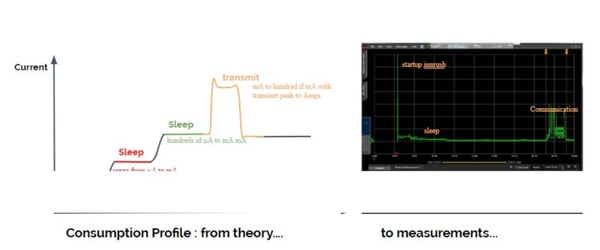
Once the product architecture has been defined, the hardware must be developed. There is a wide range of solutions available, and every day manufacturers release new CPUs and MCUs that are ever more powerful.
Multi-core architectures offer ever-increasing computational power whilst consuming less and less power.
LTE-M and NB-IoT modems are no longer simply controlled via AT commands by an external MCU; they now incorporate the MCU and offer an “all-in-one” solution.
The issues surrounding standby modes (Standby? Sleep? Deep Sleep?) remain, but technical solutions exist to achieve the ideal of ultra-low power consumption and ultra-high processing power.
However, the effort required to achieve this ideal should not be underestimated.
A thorough understanding of MCUs and CPUs is essential to utilise them effectively.
One must be wary of the illusions of the demo board and the pitfalls of the ‘off’ state (when switched off, the product no longer consumes power… but it also no longer wakes up…). The complexity of a design can reveal subtle pitfalls, such as partial power-downs and leakage. The sample code provided by manufacturers is often ‘functional’, but rarely optimised.
Simplicity should always be sought. Yet this is often hidden from the untrained eye. Experience and knowledge are essential for success. But change is constant. New technologies, new components, new protocols…
And whilst software implementation can be tricky and requires a great deal of experience, hardware optimisation can prove even more complicated… You have to “get your hands dirty”, and observation and optimisation may require tools and skills that you do not possess, but above all time – a great deal of time that you rarely have.
Energy management has become a necessity, and its successful implementation can be achieved by addressing the four questions outlined above. It also involves having a thorough understanding of the product and its requirements, and comparing these requirements with reality, its constraints, and its actual usage. To achieve this, Rtone offers a few simple recommendations:
The Agile method, widely used at Rtone, is a tool that can prove invaluable in better integrating these recommendations within the project. Methodology, knowledge and experience are all assets for achieving your Energy Management objectives, tailored to the product.
Rtone runs workshops to help you identify all the challenges in your project and understand what really matters for your product. Our workshops enable you to get your project off to a strong start by helping you fully understand your needs—beyond what you’ve already articulated! Contact one of our experts to take part in our workshops.
Demander un workshopUn peu de lecture
Des articles, des podcasts, des webinars… et surtout des conseils pratiques ! En bref, une collection de ressources pour mener à bien votre projet.