Are you about to embark on the great adventure of designing a new product? Where should you start with the pre-project phase? How can you stack the odds in your favour to ensure the success of your product development project?
Are you about to embark on the great adventure of designing a new product? Where should you start with the pre-project phase? How can you stack the odds in your favour to ensure the success of your product development project?

Are you about to embark on the great adventure of designing a new product? Where should you start with the pre-project phase?
How can you stack the odds in your favour to ensure the success of your product development project? Don’t panic – just take it step by step!
Before launching a project, there is a preliminary phase that must not be overlooked: the pre-study stage. At Rtone, we call this the “Think” stage.
We consider this stage essential, as it involves ensuring that your project is relevant, feasible and meets market demand.
This in-depth analysis of needs and the market enables us to design a product that focuses on the features essential to user satisfaction.
Failing to give this phase the attention it deserves can have real consequences down the line, particularly regarding your timeline, budget and profitability.
The aim of this first phase: to secure your innovative project.
Come on, we’re nice – in this article, we’ll give you the key steps to follow to get your project off the ground!
Fancy giving it a go? Let’s work together to devise your innovative solution right from the pre-design stage
book an appointment
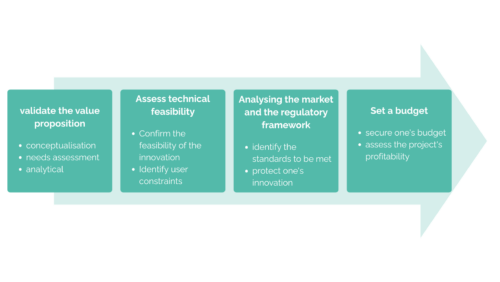
Designing a new industrial product takes time and requires a significant investment. That is why, before you get started, you need to build on a solid and viable foundation.
In practical terms, how do you validate your value proposition?
Your project must offer a genuine promise and added value compared to competing solutions.
This involves three stages, which we invite you to explore below: ideation, needs analysis and market research.
Ideation, or the generation of ideas, is a reflective process rooted in the design thinking methodology. It encourages collaborative work and draws on everyone’s creativity by building on the experience and expertise of different individuals and professionals.
This stage is user-centred and focuses on understanding the user’s ultimate needs in order to generate innovative solutions.
To ensure its success, at Rtone we have set up workshops. We start with your idea and then bring together representatives from all stakeholders during the workshops to devise solutions.
How do I put together my working team?
Make sure to bring together a variety of profiles. This allows you to combine cross-functional skills, perspectives and everyone’s experience.
The benefit of this group approach is that it leads you towards a concrete solution.
Empathy, creativity, co-creation and iteration are at the heart of this innovation method.
.png?width=558&height=558&name=%C3%8Atre%20en%20empathie%20(1).png)
Throughout the Design Thinking process, you aim to answer the following questions: Will my solution meet a real need? Will it be useful? Do people really need it?
We have a guiding principle during this stage (and throughout the project): to be agile.
In fact, agility has also inspired us for the subsequent stages of product design and development. We discuss this, for example, in this article on our various methods, inspired by agile methodologies, for balancing innovation with project delivery.
Understanding your customers’ real needs is a key factor in successful design.
Indeed, your product must have a purpose.
To put it simply: your solution must solve the problems faced by your target audience and thereby help them achieve their goals. Focus your thinking on user needs; this will ensure that your product finds its market through features that genuinely meet user expectations.
Taking usage into account right from the start of the project allows you to optimise your timeline and budget, as well as maximise your chances of success.
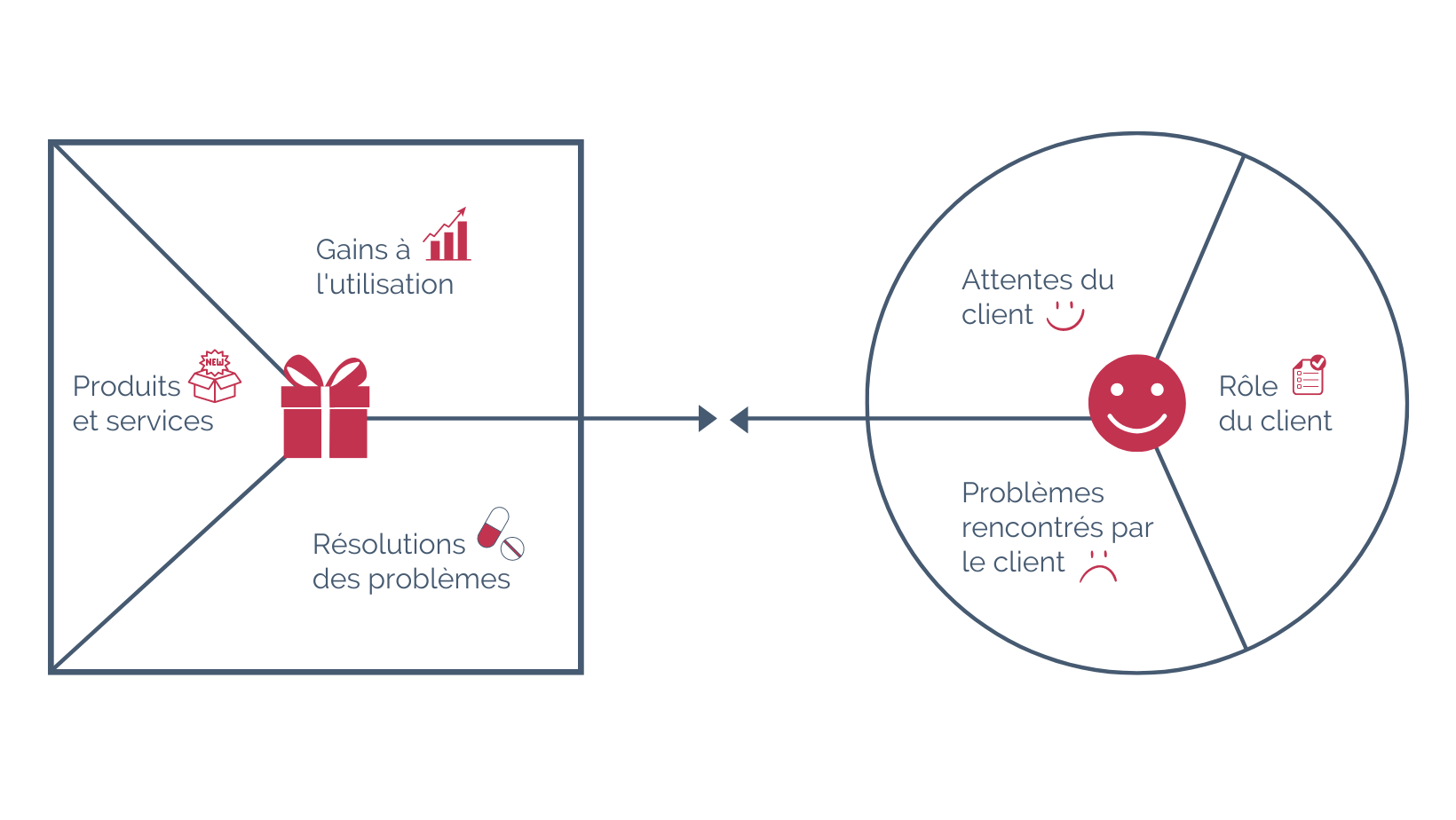
The best way to collect this data is to engage directly with your users, particularly through interviews.
To identify their needs, you should also create personas based on user categories related to the future product. Your product will become part of an ecosystem, so you need to consider end-users, but not only them… You should also take into account all the other people your solution will affect, such as buyers, technicians, and so on…
Identifying these typical user categories will make it easier for you to analyse the different usage scenarios for your product. Remember, usage scenarios must be a guiding principle and steer you throughout your project.
We discuss this in more detail in this webinar, co-hosted with Valentin Lecompte from Kuantom, a start-up that has developed a smart cocktail solution to make the art of mixology accessible to everyone.
If you’d like to watch the full replay, click here.
Now that you are confident your product meets a need, you need to understand the environment and context in which you will be launching your solution.
First, start by defining your market in broad terms: In which market will your product operate? Who are the key players in this market?
Next, you need to understand all its characteristics through an in-depth analysis.
To do this, various aspects must be taken into account:
In short, this analysis enables you to understand how the market in which you wish to establish yourself operates and, above all, to assess whether it is the right time to launch your business.
It is a key factor contributing to the success of your project in the short, medium and long term.
.png?width=680&height=383&name=R%C3%B4le%20du%20client%20(5).png)
The outline of your new proposal is taking shape; we are now moving on to refine the concept and assess its technical feasibility.
The technical feasibility study involves determining whether your project is feasible or not.
You will identify any potential issues you might encounter and select the most suitable technical solution.
Does the design align with the technical aspects?
How will your idea take physical form?
How will you integrate the various components (parts, electronics, active systems) into your product?
Before carrying out the PoC, list the project’s critical points.
Some questions to ask yourself:
For example: the size of your solution’s circuit board does not match the size of your product. We are therefore looking into ways to resolve this.
We also analyse whether all innovations have been identified and which are the most consistent with your product’s objectives.
This stage often involves compromises; sometimes we realise that certain elements are not feasible, so they need to be adjusted.
Your project and these technical elements will evolve, and that is normal. It is because we anticipate these changes that we are convinced the specification is a “false friend” and is not very representative of the actual budget.
We invite you to discover our approach in this article.
Usage constraints will influence your decision-making when selecting technical components and will pose challenges to your product design.
One or more solutions can be devised to address each constraint.
These constraints must be carefully selected before designing your solution. You will then need to ensure, throughout the project, that your product meets the requirements you have defined.
The usage constraints of an object are classified into six categories.
These include:
All these points will determine what is feasible and what is not in your project.
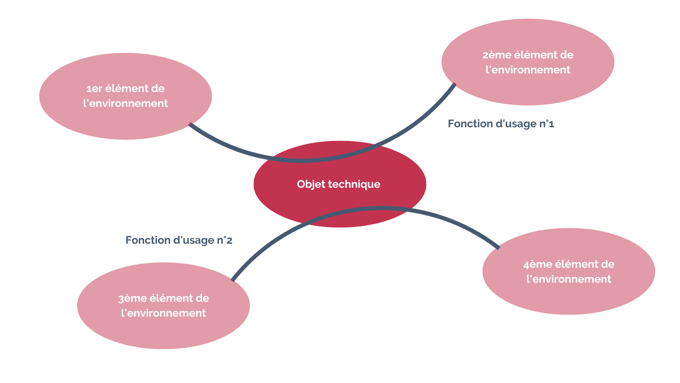
You could, for example, create a diagram known as an ‘octopus diagram’ representing the object and its environment.
This will help you identify the various functions and usage constraints of your innovative product.
Depending on your product’s intended use, it must comply with specific safety and certification standards (such as ATEX or medical standards).
It is sometimes (wrongly) assumed that this stage takes place at the end of the project. On the contrary, certain standards may require the use of specific components.
If these are not identified from the outset, this will result in significant, costly setbacks and may affect your schedule.
Take stock of your certifications, patents, private data, etc.
You should also ensure you research the standards applicable to your market, as well as the geographical scope of your product’s distribution.
There are various types of standards to consider: technical, safety, quality, etc.
Some questions to ask yourself:
We take a closer look at CE certifications in our webinar hosted by Stephen Capelli.
The concept of industrial protection should be incorporated right from the scoping phase of your project. It involves safeguarding your innovation and grants you an exclusive right to exploit your invention.
It entails a cost and will have an impact on your competitive strategy. This is why it is important to consider it right from the start of the project, particularly to gain a comprehensive overview of your project.
Industrial protection offers several advantages:
Some questions to ask yourself:
Once you have ensured that your innovation is patentable, contact the National Institute of Intellectual Property (INPI) to file your patent application.
If your innovation is not patentable or you do not wish to invest in it, there are other ways to protect it.
For example:
Failed product development projects are largely due to a lack of advance planning regarding budgetary resources.
Drawing up your budget before starting your project helps you define the scope of the work and keep costs under control. For example, it will determine the time allocated to the various phases of a project and guide you in choosing your features, components, etc.
To ensure you retain flexibility in your decision-making, carry out a financial analysis of the project, supplemented by a risk analysis, right from this pre-design stage.
A well-structured budget is one that anticipates opportunities and potential risks, thereby ensuring the project’s profitability and, consequently, its success.
Your budget should be based on a realistic estimate of your expenses and income to forecast your future results.
There are several factors to consider when drawing up your budget:
This budgeting process allows you to assess your project’s profitability and will serve as a guideline throughout its progress. It will help you compare your forecasts with actual results.
The type of contract you choose with your service provider will also have a significant impact on your budget; discover in this article the keys to successfully outsourcing your innovative project.
You can also explore this topic further with this article ‘How to ensure the successful outsourcing of an innovative project?’.
Your product is designed to enter the market and, consequently, generate profits for you.
Your preliminary work on user needs and market analysis ensures that you design a product that will subsequently be adopted.
Put simply: the more time you spend on this phase, the easier it is to define the product’s features.
Thanks to this preliminary study phase, you can focus on the minimum viable product (MVP) and set up a near-functional prototype to bring it to market quickly.
User feedback will help you identify the features and use cases that need improving to make it near-perfect and appeal to all users!
You can also start working out the final price right from the start of the project.
To do this, we create, for example, what is known as a BOM (Bill of Materials), i.e. a comprehensive list of all parts and components to get an initial idea of the product’s price. This then provides an indication of margins with retailers and distributors.
Added to this is an analysis of the market and your sales prospects.
Profitability should be at the heart of your thinking. We explain everything in this video with Adil Bentahar, Chief Financial Officer at Rtone.
In short, investing your time and resources in this “Think” phase can only be beneficial to the success of your project.
It safeguards your project, ensures agile management, and strengthens your idea. It also guarantees that your innovative solution meets real needs and is adopted by your users.
This stage was, in fact, a cornerstone for our client Satab, who embarked on a transformation through innovation. Here is their video testimonial:
Un peu de lecture
Des articles, des podcasts, des webinars… et surtout des conseils pratiques ! En bref, une collection de ressources pour mener à bien votre projet.